Detailed imaging for a clearer understanding of pain or injury
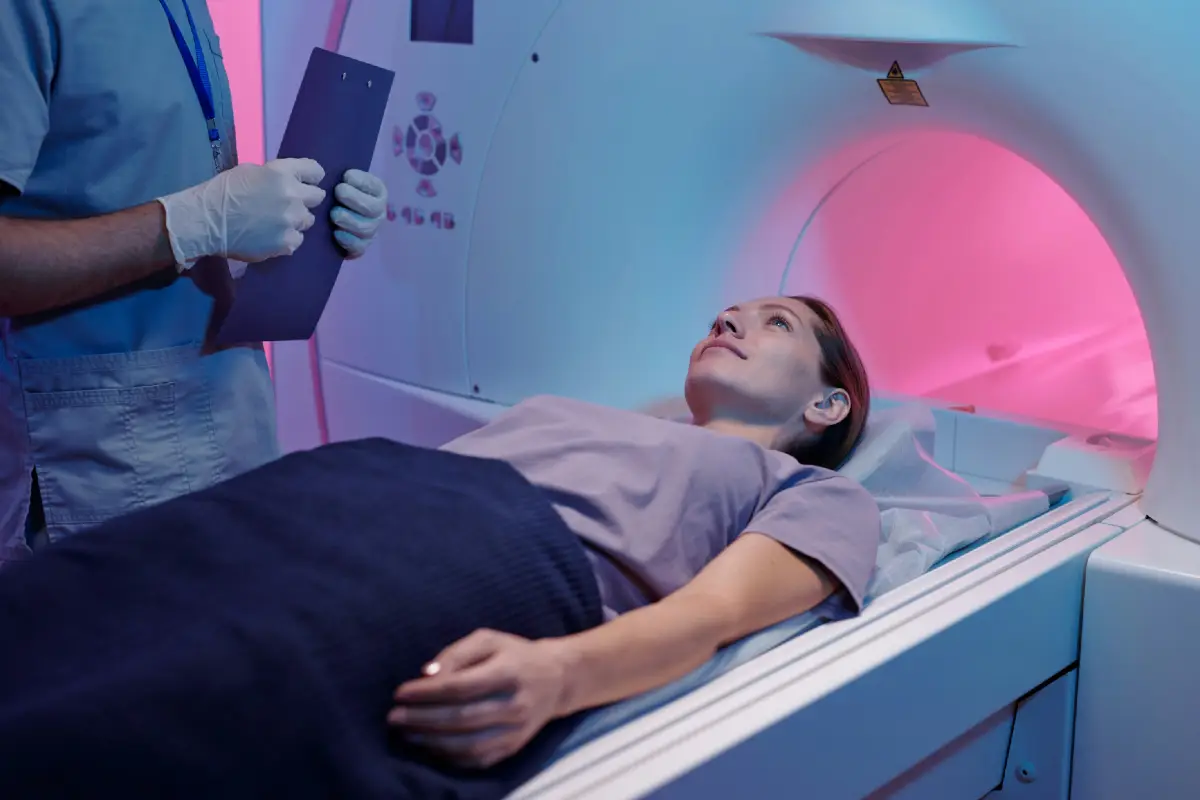

Magnetic Resonance Imaging, commonly known as MRI, is a detailed scan used to assess many musculoskeletal and sports medicine problems.
It can be helpful when symptoms involve joints, muscles, tendons, ligaments, cartilage, discs or deeper soft tissues that cannot be fully assessed with a standard X-ray.
Dr Jones may recommend an MRI scan when symptoms, examination findings or previous imaging suggest that more detailed information is needed.
The aim is to use MRI sensibly, alongside your history, examination and goals, so the scan helps guide a clear and practical treatment plan.
An MRI scan uses a strong magnetic field and radio waves to create detailed images of the inside of the body.
It does not use X-ray radiation.
MRI can show soft tissues in much greater detail than a standard X-ray, including muscles, tendons, ligaments, cartilage, bone marrow and structures inside a joint.
It is often used when a diagnosis is unclear, when symptoms are not improving as expected, or when more information is needed before deciding on treatment or referral.
An MRI scan may be useful if you have persistent joint pain, swelling, stiffness, reduced movement or symptoms after an injury.
It may also be considered if there is concern about a ligament injury, cartilage injury, tendon tear, muscle injury, stress fracture, disc problem or deeper soft tissue issue.
MRI can be particularly helpful when symptoms have not settled with physiotherapy, rest, activity modification or other non-operative treatments.
The decision to arrange an MRI is based on whether the extra detail is likely to help explain your symptoms or change the treatment plan.
MRI imaging can help assess a wide range of musculoskeletal problems, including:
The scan findings are always considered alongside your symptoms and clinical assessment.
MRI can show very detailed changes, but not every finding on a scan is necessarily the cause of pain. The most useful treatment plan comes from matching the image with the person.
MRI is commonly used in sports medicine when a more detailed view of an injury is needed.
This may include knee ligament injuries, meniscus tears, muscle injuries, tendon problems, ankle injuries, shoulder pain, hip pain or symptoms that are not recovering as expected.
For athletes and active patients, MRI can help clarify the diagnosis, estimate the severity of injury and guide decisions around rehabilitation, return to training or referral.
It can also be useful when symptoms are lingering and the reason for slow recovery is not clear.
MRI may also be useful when assessing longer-term joint pain.
It can help show structures inside and around the joint, including cartilage, ligaments, tendons, bone marrow and inflammation.
This can be helpful when X-rays do not fully explain the symptoms, or when there is a need to understand whether pain is coming from arthritis, soft tissue irritation, injury or another cause.
The scan result can then be used to guide options such as physiotherapy, activity modification, injection therapy, bracing, further imaging or referral where appropriate.
Different scans are useful for different reasons.
X-rays are often used to assess bones, joint space, arthritis and alignment.
Ultrasound is useful for many tendon, muscle, ligament, bursa and soft tissue problems close to the surface, and can also be used to guide injections.
CT scans are particularly useful when detailed bone and joint structure needs to be assessed.
MRI is especially useful when deeper soft tissue, cartilage, ligament, tendon, disc or bone marrow detail is needed.
Dr Jones can advise which scan is most suitable based on your symptoms, examination and what needs to be understood.
During an MRI scan, you will usually lie on a scanning table while the area being assessed is positioned inside or near the scanner.
The scan is painless, but it can be noisy, and you will usually need to stay still while the images are taken.
Depending on the area being scanned, the appointment may take longer than an X-ray or CT scan.
Some patients may feel uncomfortable in enclosed spaces. If this is a concern, it is worth mentioning before the scan so the options can be discussed.
MRI does not use X-ray radiation, but it is not suitable for everyone.
Because MRI uses a strong magnet, you will be asked safety questions before the scan. This is particularly important if you have certain implants, pacemakers, metal fragments or previous surgery involving metalwork.
In some cases, contrast dye may be used, although this depends on the reason for the scan and will be explained beforehand if needed.
Dr Jones will only recommend MRI where it is likely to provide useful information for diagnosis, treatment planning or onward referral.
After your MRI scan, the images and report can be reviewed alongside your symptoms, examination findings and any previous imaging.
Dr Jones can explain what the scan shows, which findings are likely to matter and how they fit with your symptoms.
This may lead to advice, physiotherapy, activity modification, injection treatment, further imaging or referral to another specialist where needed.
The aim is to turn the scan result into a clear, practical plan.
If you are struggling with joint pain, soft tissue symptoms, injury-related pain or an MSK problem that has not settled as expected, an assessment can help decide whether MRI imaging is appropriate.
Dr Jones can review your symptoms, arrange suitable imaging where needed and guide the next step in your treatment plan.
We use cookies and similar technologies to improve your experience on our website. Read our Privacy Policy.