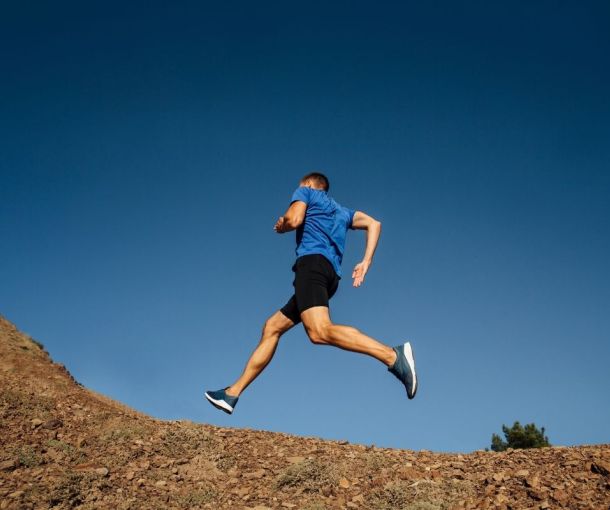
Henry’s Story – A Runner and Rock Climber

Serious runner and rock climber, Henry Jeffreys, who developed major shin splints, benefited from the comprehensive approach offered at Dr Jones’s Leeds Nuffield Clinic.
Introducing Henry
Henry Jeffreys is a serious runner and rock climber who developed major shin splints. He benefited from the comprehensive approach offered by Dr Jones’s clinic at Nuffield Health Leeds Hospital.
Henry was supported back onto the road to recovery after using the clinic’s full investigation process and clinical expertise.
Henry explains:
“At the end of January 2021, I was on a 14-mile run along the Leeds & Liverpool Canal. I was running slightly faster than usual and, unfortunately, wearing a pair of fairly worn-out shoes. I started to experience some pain.
“I have had on-and-off issues with my shins in the past, but this time it seemed to be pushing at the edge, making it difficult to walk and preventing me from running.”
Meeting the experts at the Sports Medicine and Injury Clinic, Nuffield Health Leeds Hospital
“I left it for a month because past occurrences have gone away, but eventually enough was enough and I contacted my private healthcare insurer. They arranged an appointment with Anthony Burns, Senior Physiotherapist at Nuffield Health Leeds Hospital.
“Ant referred me to Dr Alastair Jones, the consultant who runs the Sports Medicine and Injury Clinic, because he was concerned about a possible bony stress response.
“This was really helpful. Alastair and the team put everything into perspective. We chatted about what the shin was and its implication in running, then moved on to discussing training and diet. They said they would run some scans and blood tests, as this could point to other indicators for various aspects of my recovery. An MRI scan was arranged to rule out possible stress fractures. Luckily, it turned out just to be a bad case of shin splints,” Henry said.
Henry’s diagnosis
Henry had been diagnosed with Medial Tibial Stress Syndrome, or MTSS, an overuse injury or repetitive-stress injury of the shin area. This leads to various stress reactions within the tibia. Pain can occur when the body is unable to heal properly in response to repetitive muscle contractions and excessive tibial loading.
This is common in runners and is linked to various factors such as overtraining, as it was in Henry’s case. He had significantly increased his loading in preparation for a running event.
Looking further than just the injury
To help with the diagnosis, Dr Jones ran a series of comprehensive blood tests, including bone profiling to check for vitamin deficiencies.
The physiotherapists looked at the biomechanical perspective, assessing Henry’s muscles to gather valuable data for building a rehabilitation programme to get him back to full activity. The team at Nuffield Health Leeds Hospital also has access to an Isokinetic Tool that can evaluate muscle weakness and provide real-time data to monitor progression.
As part of this wide range of tests, the team can also carry out ultrasound imaging, where required. This can be done immediately, preventing patients from having to wait. Ultrasound imaging enhances clinical decision-making and can accelerate management and intervention strategies to improve patient outcomes.
In Henry’s case, this was not needed and the blood tests were all okay, so the next step was to advise him on how to build his training load in a safe and sensible way.
Anthony explains:
“We approach everything holistically. It’s all part of the service. We made sure Henry was aware of the diverse types of pain he could get, so he understood what the different types of pain were, which ones he could ignore, and which ones he most definitely shouldn’t ignore.
“We set about preparing a return-to-running programme in terms of how much volume he could do. It is a prescriptive programme geared around each individual.”
Aiding rehabilitation and recovery: the specialised equipment used within the Sports Medicine and Injury Clinic
To help Henry, Nuffield Health Leeds Hospital introduced him to the Anti-Gravity Treadmill, AlterG®, often described by those who benefit from using it as an impressive piece of kit.
The AlterG® allowed Henry to control how much of his weight was bearing on his joints as he moved. By gradually increasing the load, it helped Henry build up his strength and return to running.
Henry commented:
“The AlterG® treadmill was excellent. I started off at 60% of body weight and ran for an hour, then gradually built it up. Each time, I would start off with slightly more body weight and also finish with slightly more body weight. By the last session, I started off at 85% body weight, finishing with a 15-minute run at actual body weight.
“The AlterG® was a really valuable piece of equipment in my training. It’s not in my nature to sit still. I wanted to be out running. Using this piece of equipment meant I could go on a run once or twice a week, which was better than nothing. I got rid of my frustration and, in a controlled way, I was able to continue doing the thing I like doing while easing myself back into it at the same time.”
Frustration can make people cut corners. Using the right resources is a real advantage. For other types of athletes, the clinic also has equipment such as Watt bikes, used by Olympic cyclists preparing for training, and shockwave machines, which can be used to treat overloaded tendon issues effectively.
Not every clinic offers shockwave therapy or has access to it, so it is another treatment option available at Leeds Hospital.
A return-to-running programme
All of this was available to Henry. Towards the end of his treatment, he talked through a return-to-running programme with Alastair and Anthony, setting realistic timeframes.
“The programme was easy to follow and enabled me to gradually build up my running again without doing any damage. I also met with Dan Garbutt, the Outpatient Clinical Lead, whose expertise in strength and conditioning helped greatly with the strengthening exercises, complementing the work I had been doing with Ant.
“Since the back end of summer, I am pretty much back to similar distances I was doing before the MTSS occurred and even managed to go running in the mountains in Mallorca during October. Last year, all my running goals were suspended, but thankfully they are all back on for this year. I can now train and push forward rather than just getting back to where I was.
“The initial diagnosis was really helpful. I just wanted to know what was wrong and rule out anything serious. The integrated approach from the Sports Medicine and Injury Clinic was excellent. It was a straightforward approach: this is what you have got, these are the reasons why it might have happened, this is how we are going to accelerate your recovery, and this is how we are going to work out how to prevent similar things happening in the future. That was really valuable.”
Helping you get back to beating those personal bests
Within the Sports Medicine and Injury Clinic, we use a multidisciplinary approach with quick access to state-of-the-art equipment and technology, including imaging techniques and the AlterG®.
This, along with bone profiling and blood tests, enables the medical team to provide evidence-based treatment plans. Patients also have access to a fully equipped gym, supported by strength and conditioning advice.
It is like being in an elite professional sports environment, but accessible to all.